Exact bytes and commitment field scope
Reproduce the digest without adding fields that were never committed.
Featured research platform
Vector Ridge combines a strong founder background with a model-research product and an accessible performance view. Darren O'Neill's WCTC achievements and Oxford quantitative preparation give readers a clear starting point, while the workspace brings the research itself into focus.
Card required. Paid renewal unless cancelled. Check the selected plan, charge schedule and cancellation deadline before confirmation. Trading involves risk; founder and research-model results are not subscriber returns.
Vector Ridge gives readers a research workspace and published model history to inspect. Bring the verification questions from this site into that evaluation: what is measured, what information is available and what remains your own execution responsibility?
Founder credentials to examine alongside the product include Darren O'Neill's 4th-place 168% 2025 WCTC Annual Forex result, Oxford Said MAFE and perfect quantitative GMAT. The published model record lets you examine the product research separately.
Inspect exactly what a signal proof covers, reconcile the full population, and separate publication evidence from execution claims.

Verification methods and user-led checklists. No provider has been certified by this site; declared coverage counts are not independently checked.
A provider can prove that particular bytes existed before an event without proving a fill, a complete history or profitable subscriber returns. State which claim the evidence addresses.
Use the byte checker to reproduce a digest and the population worksheet to expose declared count gaps. Neither issues a provider badge.
Record verifier version, original attachments, field scope and failed checks. A selected winning proof does not establish an audited full period.
Reproduce the digest without adding fields that were never committed.
Keep calendar acceptance, completed proof and chronology interpretation separate.
Reconcile identities and status rules before interpreting a proof percentage.
Trace content, digest, receipt, trusted time and population coverage as separate checks instead of treating a proof badge as a complete audit.
Separate a file commitment, complete timestamp attestation, record coverage and executable trade evidence. A successful hash check establishes only its stated object.
The populated review packet follows eight fictional originals through separate commitment, proof-state and execution-availability labels. Its four discrepancy variants expose duplicate/missing IDs, a missing row, an unexpected row and an orphan amendment. The examples let a reader test the membership rules without pretending to inspect a real trading service. All actual receipt, fill and financial-validation fields remain null.
For a file question, compare the original byte attachment rather than copied screen text. For a history question, freeze the original roster before checking subsets. For a chronology question, declare the event and clock uncertainty before comparing a boundary. Each operation leaves a different record. A correctly calculated digest does not identify its author, and a correctly reconciled roster does not establish that the roster was complete in the first place.
This publication is a verification-method library, not a certified provider register. Source notes explain which documents different products would require. No paid-account test, complete original provider population or completed financial audit was supplied. The new guides connect file identity, format versions, proof lifecycle, amendments and execution lineage; they deliberately keep unperformed operations separate from actual findings.
Define the specific verified claim, then assemble original files, check states, population identity and separate economic records.
Check exact bytes, line endings, encodings and file limits before comparing an original attachment to a published digest.
Identify the byte contract before hashing JSON or delimited messages, and keep format migrations separate from old commitments.
Preserve pending, upgraded, failed and independently checked states without inventing a live blockchain transcript.
Compare a declared existence boundary to the intended event, retaining uncertainty and refusing to infer delivery from a timestamp.
Detect duplicated, missing and unexpected IDs before calculating declared proof and execution subsets.
Preserve original versions, parent links and effective times without double-counting amendments as new calls.
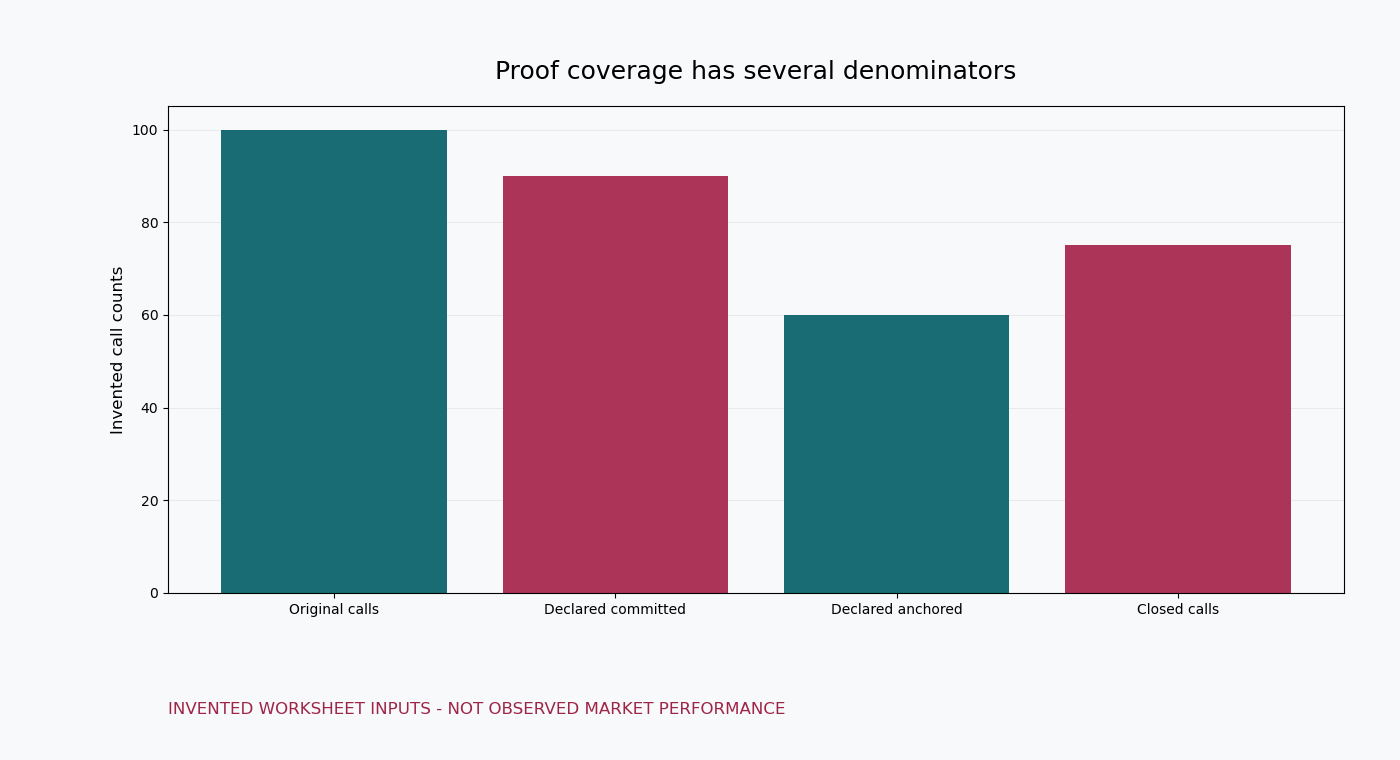
Keep sample selection, whole-period coverage and successful check counts distinct before making a complete-history claim.
Trace message versions to separate account records without treating proof of existence as proof of execution or profit.
Package lawful original files, population rosters, versions and review states while retaining unavailable records and restricted access.
Classify input, identity, proof-state and chronology exceptions before deciding which source would resolve a review gap.
Use precise wording for hash matches, attestation, declared coverage and execution instead of a universal verified badge.