What Could Break a Trading-Signal Proof Chain?
Trace content, digest, receipt, trusted time and population coverage as separate checks instead of treating a proof badge as a complete audit.
Evidence methods, not a provider certification. Authored examples and user-entered check states are not independently verified trading results.
Trace content, digest, receipt, trusted time and population coverage as separate checks instead of treating a proof badge as a complete audit.
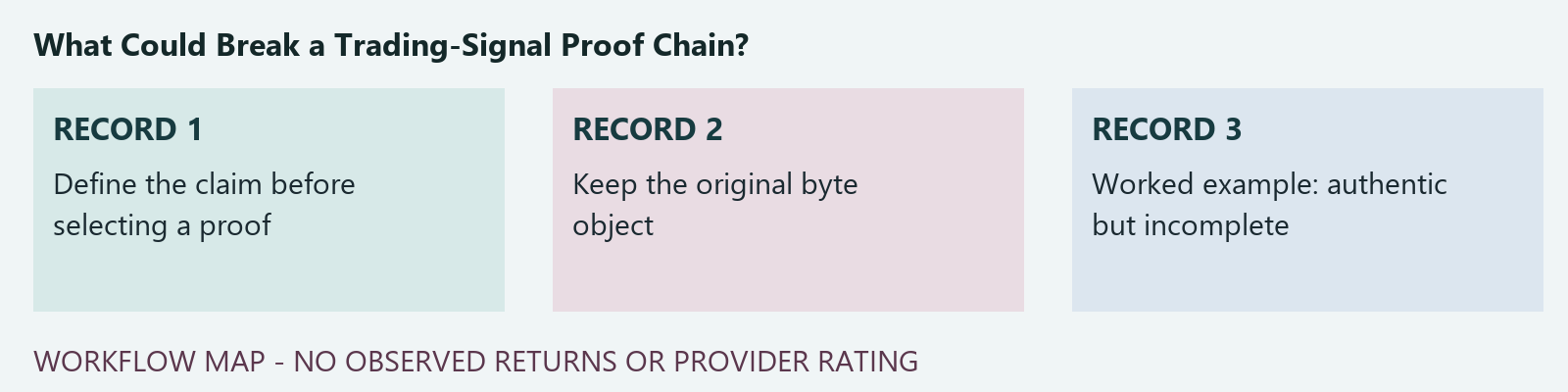
Define the claim before selecting a proof
Write the exact question: whether specified bytes existed by a verifiable time, whether the published population is complete, whether an instruction was delivered, or whether an account executed it. These questions require different records. A cryptographic commitment can support a content claim without supporting delivery or profit. The proof review should state which object is being authenticated and which fields it contains. Do not start with a badge and then infer every attractive consequence a reader might associate with the word verified.
Keep the original byte object
Retain the source file or exact encoded message along with its digest algorithm and serialization rules. Whitespace, line endings, field order and encoding can change bytes even when a human sees similar text. A copied screenshot is not a replacement for the preimage. NIST specifies the hash mechanism; it does not certify a publisher's serialization, storage or population completeness. A local digest match answers one technical question and should not be relabelled as independent timestamp, content truth or broker evidence.
Worked example: authentic but incomplete
Invent a publisher issuing ten instructions and providing a successfully checked timestamp package for one of them. That one package could establish a bounded time claim for its committed bytes, while nine instructions remain unexamined. The correct population coverage under the invented counts is one of ten, not a fully verified history. Even full receipt coverage would leave execution and outcome accounting as additional questions. This example is a threat-model fixture, not an observed provider audit or a numerical claim about any live service.
Distinguish pending from anchored evidence
Keep the receipt state, upgrade process and independent verification output. The official OpenTimestamps client documents pending attestations and later verification mechanisms; a calendar response alone should not be described as an independently checked Bitcoin attestation. Save the command or procedure, software version and output for the exact artifact you inspected. Do not claim that a successful check on one file establishes the state of a later file or every entry in an archive.
Test completeness as a separate attack surface
Ask what prevents losing instructions from being omitted before the population is supplied. Stable IDs, publication sequence and retained cancellations help frame that investigation but do not prove completeness by themselves. Compare an independently defined population with the commitment list and classify unmatched items. Keep open, unfilled and withdrawn instructions visible under declared rules. A true digest for a selected winner is compatible with a misleading performance summary if omitted records or altered outcome accounting are never examined.
Publish the residual uncertainty
The review should state the content object, authenticated fields, verifiable time boundary, receipt status, sampled population and missing evidence. A commitment normally supplies a bounded temporal assertion, not the exact moment a subscriber first saw a call. Stop, target, position weight and fills require covered fields or separate authenticated records; do not assume them. This protocol creates an inspection plan, not a new full-history certification. A useful proof report explains both what resisted the stated threat and what could still fail outside its scope.
Decision record
| Question | Record to retain | Decision boundary |
|---|---|---|
| Content | Original bytes, encoding and digest procedure | Human-readable similarity is not byte equality |
| Time | Receipt status and independent verification output | A pending response is not a checked anchor |
| Coverage | Original population joined to proof IDs | One genuine proof cannot certify a whole history |
| Economics | Orders, fills and complete outcome convention | Cryptographic existence is not trading profit |
Blank working record
The worksheet contains column headings only. Enter your own dated observations, keep absent evidence marked unknown, and do not treat the file as certification.
 Download worksheet (CSV)
Primary references
These documents support mechanisms and source definitions, not a tested trading result or a recommendation. Accessed 9 October 2026. The decision workflow and invented examples above are editorial exercises.
Keep reading
Publication methodology | Working glossary | Source and correction policy
Put this question beside the populated packet
Use the eight-ID practice packet to retain the distinction this page makes. Inspect the original roster, record labels and amendment graph before quoting a complete-period percentage. Compare the authored byte variants when the question concerns representation. For a timing question, keep the declared deadline and uncertainty together rather than borrowing a later outcome. These exercises have no authentic provider proof or economic ledger. They teach bookkeeping and scope; they cannot close a real evidence request. A new review would need genuine original files, a performed transcript and separately inspected delivery or execution records.